The most expensive roof repair is the second one
Which is why the first one has to be aimed at the right place. When you ring, describe the water and nothing else: the room, the wall, how high the stain sits, and whether it comes with wind or with volume. That is where the search starts, and it is worth being precise about, because it is also where most leak repairs in this metro go wrong.
Almost every homeowner describes a leak the same way, and the description is always accurate and almost always misleading: there is a brown ring on the ceiling in the back bedroom, and it grows when it rains hard from the south. What that sentence tells a roofer is where the water finished. It says very little about where the water started.
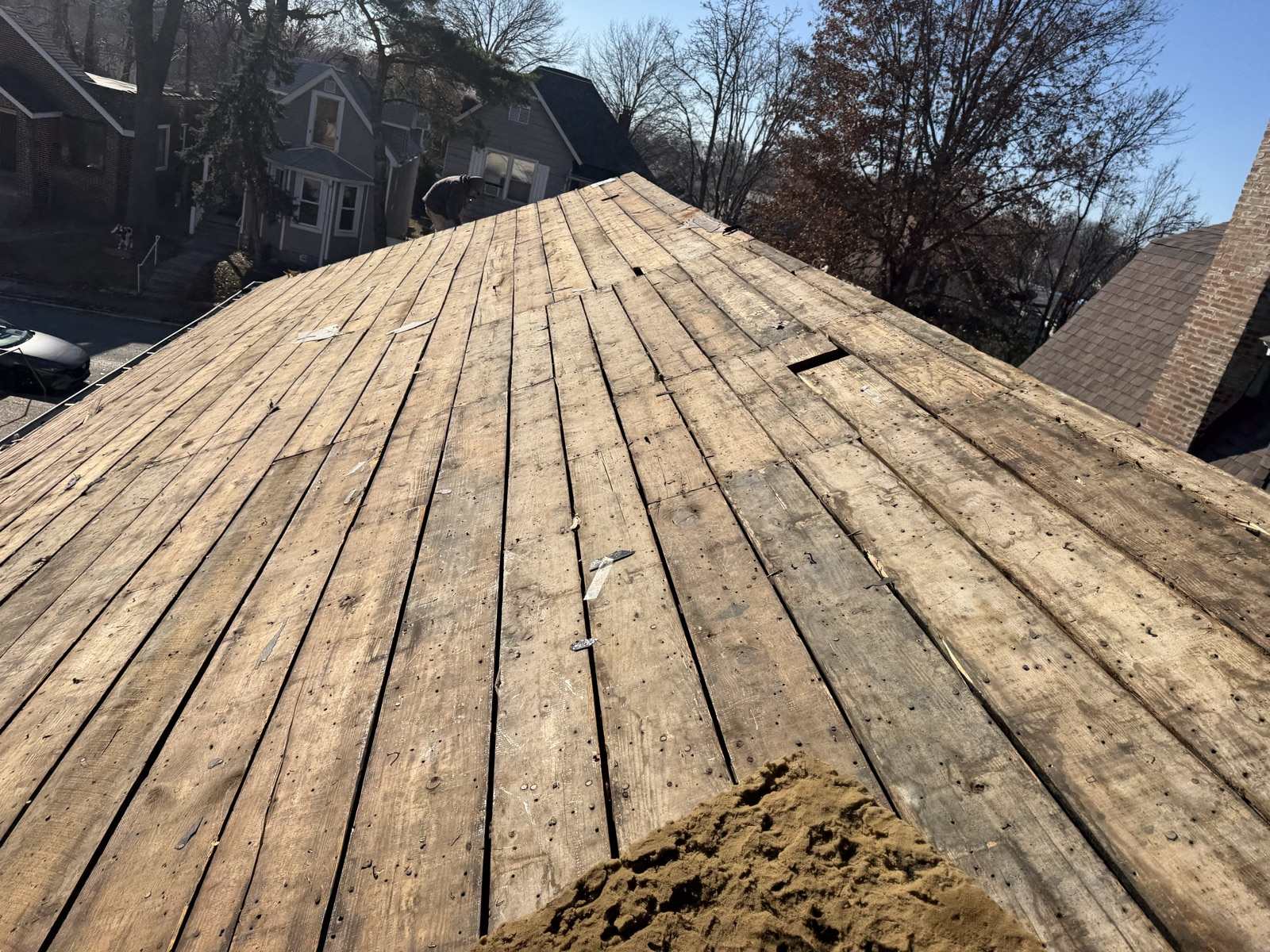
Asphalt shingles are not a waterproof membrane. They are a shedding surface, a set of overlapping tabs designed to move water down the slope faster than gravity can push it sideways. Under them is the underlayment, and under that is the deck, which on a great many older St. Louis houses is not plywood at all but wide sawn planks laid with a deliberate gap between them. When water gets past the shedding surface, it does not fall straight through the deck. It runs. It follows the felt to a lap, it follows a plank seam across the slope, it finds a rafter and runs down the side of it, and it keeps going until it hits a horizontal member, a bit of insulation, a wiring run or a light box that finally stops it and lets it soak downwards.
That travel is usually a few feet. It is frequently ten or twelve. On a low slope it can be the width of a room. So a repair aimed at the ceiling stain is a repair aimed at a spot on the roof that, in a great many cases, was never leaking at all. The sealant goes on, the invoice gets paid, the next storm arrives from the same direction, and the stain grows.
Why the second repair costs more than the first
Seal where the water appears and you have waterproofed a piece of roof that was already dry.
What happens between your call and the file in your hand
- FirstA conversation about the water, not the roof Where is it showing, which room, which wall, how high up, does it come with wind or with volume, is it only in a long soaking rain or in any shower at all. Those answers narrow the search before anyone gets a ladder off the truck.
- SecondInside and up, before outside and up Where an attic can be entered, the underside of the deck is looked at first, because water leaves a track on wood and insulation that survives long after the ceiling has dried.
- ThirdThe suspect details, in order of likelihood Uphill of the stain and to either side. Boots, flashings, valleys, fasteners, then anything that has been sealed before, because a previous repair is itself a strong clue.
- FourthPhotographs and a written scope What was found, where, and what it will take to correct, in writing, with pictures of the actual roof rather than a catalogue. Yours to keep and yours to compare against.
- ThenYour decision, on paper Repair, or repair now and plan a replacement, or replace. All three are legitimate answers and which one is right depends on the roof, not on the call.
Where roofs actually leak in the St. Louis metro
Almost never in the middle of a shingle field. Roofs here fail at their details: at the places where something passes through the roof, meets a wall, or changes direction. Each of the six below has its own page on this site, because each one has a different failure mode, a different way of being found and a different honest answer about whether it is worth repairing.
Entry one
Pipe boots
The rubber collar around a plumbing vent. Missouri sun perishes it and it splits, usually long before the shingles around it are anywhere near finished. Probably the most common single leak in this metro.
Entry two
Step flashing
Where the roof meets a wall or a chimney. When it leaks it is very often because it was installed wrong years ago, not because it wore out, and that changes what the repair is.
Entry three
Valleys
Everything two roof planes shed gets funnelled into one line. Volume, speed and debris all concentrate there, so a valley fails earlier than the field either side of it.
Entry four
Nail pops
Freeze and thaw walks a fastener back out of the deck. It tents the shingle above it, and the hole it came from is now an open hole in the roof with a shingle held off it.
Entry five
Ice dams
A cold snap after a thaw refreezes meltwater at the cold eave. The dam holds standing water on the roof and pushes it backwards, uphill, under the shingle laps.
The other answer
Or the roof is finished
Sometimes the honest answer is that the leak is a symptom, the roof is at the end of its service life, and a repair buys a season. That is a different conversation and it should be described as one.
Why roofs here fail at their details rather than their surfaces
Missouri gives a roof two opposite loads inside a single year, and they work on the same parts. In winter, moisture in the deck and around a fastener freezes and expands, then thaws, then freezes again, and each cycle walks the fastener a fraction of a turn back out of the wood. In July, the surface of a dark roof deck in this humidity runs far hotter than the air, the deck dries, the sheathing moves, and every rubber and mastic component on the roof, the boots especially, gets cooked and loses its elasticity.
So the field of the roof, which is just overlapping asphalt doing an easy job, ages slowly and predictably. The details, which are the parts made of rubber, metal, sealant and fastenings, get worked hard in both directions. That is the reason a roof in this metro will typically leak years before it needs replacing, and the reason a leak is not automatically an argument for a new roof.
What you are holding at the end of it
Photographs of your own roof, taken from on it. Measurements. A written scope naming the fault, where it is, and what correcting it involves. You keep all three whether or not you hire anybody, and it is the document you put next to the next quote somebody hands you at your front door.
Keys does roofing, gutters and downspouts. Not siding, not windows, not commercial work. The shingles installed are Atlas and Malarkey. If a leak turns out to be a plumbing vent that has come apart inside the wall, or condensation from an unvented bathroom fan dripping onto the back of the ceiling, you get told that on the day, and a roofer is not the trade you need.
On insurance, the file is the whole point. RSMo 407.725 bars a roofing contractor from representing or negotiating on a property owner's insurance claim, so what Keys brings instead is photographs, measurements, a written scope in your hand, and attendance on site as the contractor when an adjuster comes out. A leak from ordinary wear is usually not a claim at all, which is covered on a leak and your insurance.
Common questions
How far can water travel before it drips?
On a steep roof with a solid deck, often only a foot or two. On plank decking it regularly runs several feet along a board seam. Down the side of a rafter it can travel the full length of the rafter, which on a two storey house means the water enters near the ridge and shows up at the eave wall. Low slope roofs are the worst case, because there is very little gravity pulling the water down through the assembly and a great deal pushing it sideways.
Can a roof leak be repaired, or does the whole roof have to go?
Most leaks in this metro are repairs. A perished boot, a length of failed step flashing or a handful of popped nails are all discrete faults on a roof that is otherwise doing its job. The roof stops being repairable when the shingles have lost enough granule and flexibility that lifting them to work under them breaks them, or when the deck itself is soft. See repair or replace.
My ceiling only stains in a driving rain from one direction. Why?
Because the entry is almost certainly not a hole that gravity can find on its own. Wind driven rain gets pushed up under a lap, past a headwall, or in behind a piece of counter flashing. A roof with a wind dependent leak is a roof with a detail problem, and it is one of the more findable kinds because the direction of the wind tells you which side of the house to search.
Should I go up and look myself?
No. An asphalt roof with a leak is a roof with wet, possibly rotten decking somewhere on it, and you will not know where until you are standing on it. Look from the ground with binoculars if you want, and look in the attic if there is safe access. The roof itself is not worth the risk.