The sequence
If a stain appeared during a winter thaw with no rain falling, that is ice and not a hole, and sealing the roof will not touch it. The month to have it looked at is this one. The work that stops it recurring is attic work, ventilation and insulation at the eave, and none of it can be done with snow on the roof or a dam already sitting on the edge.
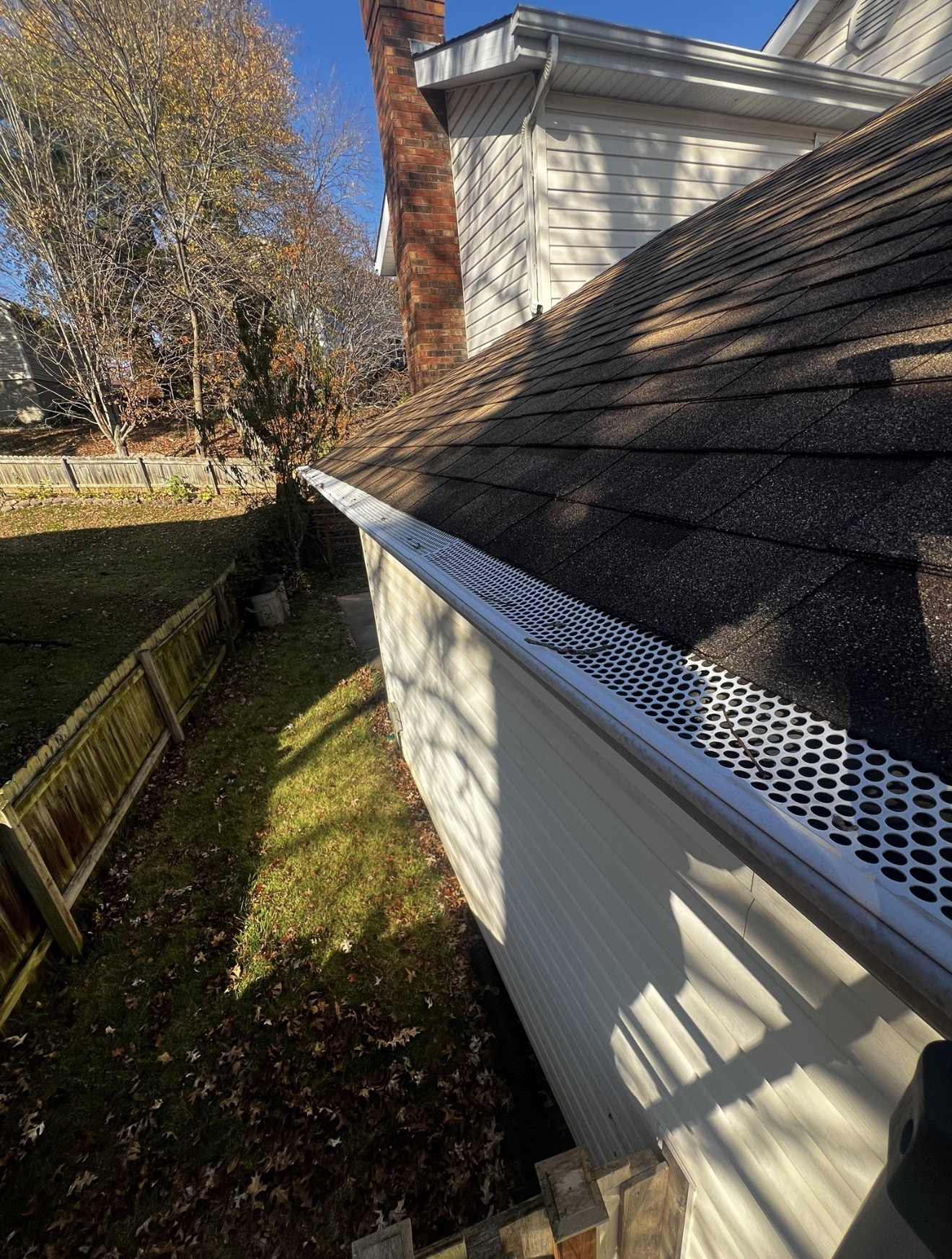
An ice dam needs a specific set of conditions, and a St. Louis winter supplies them several times most years. There is snow on the roof. The attic is warm enough, from heat escaping the house, to warm the underside of the deck above the heated part of the building. The snow on that part of the roof melts from below, even though the air outside is well under freezing. The meltwater runs down the slope, and when it crosses the line where the roof stops being over heated space, over the eave and the overhang, it reaches a surface that is at the temperature of the outside air. There it refreezes.
Do that for a night or two and there is a ridge of ice sitting along the eave. Now the meltwater arriving behind it has nowhere to go, so it stands. Standing water on a shingle roof finds its way under the laps, and because the dam is holding the level up, the water works backwards and upwards, past courses that have never been asked to be watertight from underneath.
Why the cause is usually inside
Nothing in that sequence is a fault of the shingles. The roof is being asked to be watertight against standing water working uphill, which no shed surface can do. The controllable part is the heat that melted the snow in the first place, and that is an attic problem.
Air leakage
Warm house air escaping into the attic through gaps around light fittings, loft hatches, plumbing and wiring penetrations and the tops of interior walls. This is usually the biggest single contributor and the one most often ignored.
Insulation
Too little of it, or compressed, or missing over part of the ceiling, lets conducted heat reach the deck. The worst spots are usually at the outside walls, where insulation gets pushed down by the roof line.
Ventilation
Intake at the soffit and exhaust at the ridge should be flushing the attic with outside air so the deck stays close to outside temperature. Blocked soffit vents, or exhaust with no intake to feed it, defeat that.
Ducts and fans
Heating ducts running through an unconditioned attic, or a bathroom fan discharging into the attic instead of outside, deliver heat and moisture straight to the underside of the deck.
The uncomfortable part
An ice dam is a heat problem that presents as a roof problem, so the roof is what gets sold.
What a roofer can honestly do about it
Several things, and it is worth being clear about which are cures and which are defences.
- Ice and water membrane
- A self adhering waterproof membrane run up the slope from the eave, under the shingles. It does not stop a dam forming. It stops water that gets past the shingles from reaching the deck and the wall. This is a defence, it is standard practice on a replacement, and it is the single most effective roofing answer.
- Ventilation work
- Clearing or adding soffit intake and matching ridge exhaust so the deck runs colder. This addresses the cause and is roofing work.
- Gutter and downspout capacity
- A gutter full of frozen debris gives the dam a head start. Clearing and correctly falling the gutters helps at the margin.
- Air sealing and insulation
- The actual cure in most houses, and it is insulation and air sealing work rather than roofing. Keys does roofing, gutters and downspouts, so if that is what your house needs, you will be told so.
What not to do while it is happening
- Do not chip at it. A hammer, a chisel or a spade against ice sitting on asphalt shingles breaks the shingles, and you will have converted a seasonal problem into a permanent hole.
- Do not put rock salt in a sock on the roof. It is a widely shared idea. It corrodes metal flashings, fasteners and gutters, and kills whatever is planted where the meltwater lands.
- Do not climb up. Icy roof, freezing hands, ladder on frozen ground. This is how people get badly hurt every winter.
- Do relieve water inside. If a ceiling is holding water, see before the roofer arrives.
Why the stain from an ice dam is confusing
Because the water enters over a wide area rather than at a point, and because it enters at the coldest, lowest part of the roof, an ice dam typically stains at the top of an outside wall, or in a line along it, rather than in the middle of a ceiling. It also frequently appears days after the weather that caused it, once the dam melts and releases what was held behind it. A homeowner who gets a wall stain in a January thaw, with no rain at all in the forecast, is very often looking at last week's ice.