What a nail pop actually is
A leak that only shows in a hard rain and dries up in a light one is the classic fastener pattern. If that is yours, say so when you ring, because it changes where somebody starts looking and because it is read across a whole roof plane rather than at one spot. It is a same visit finding, and you get the count and the photographs at the end of it.
Shingles are fastened through into the deck. Each nail does two things: it holds the shingle course down, and it seals its own hole, because the shank is a tight fit in the wood and the head sits flat against the shingle with the next course lapped over it. When the nail backs out, both of those stop being true. The head rises, pushes up the shingle above it and tents it, so wind can get under the course. And the shank is now loose in a hole that is open at the top of the deck.
From the ground a popped nail is very hard to see. What you can sometimes see is the symptom: a small raised bump in an otherwise flat shingle course, or a line of them, because the nails in a course were driven at the same time to the same depth in the same board.
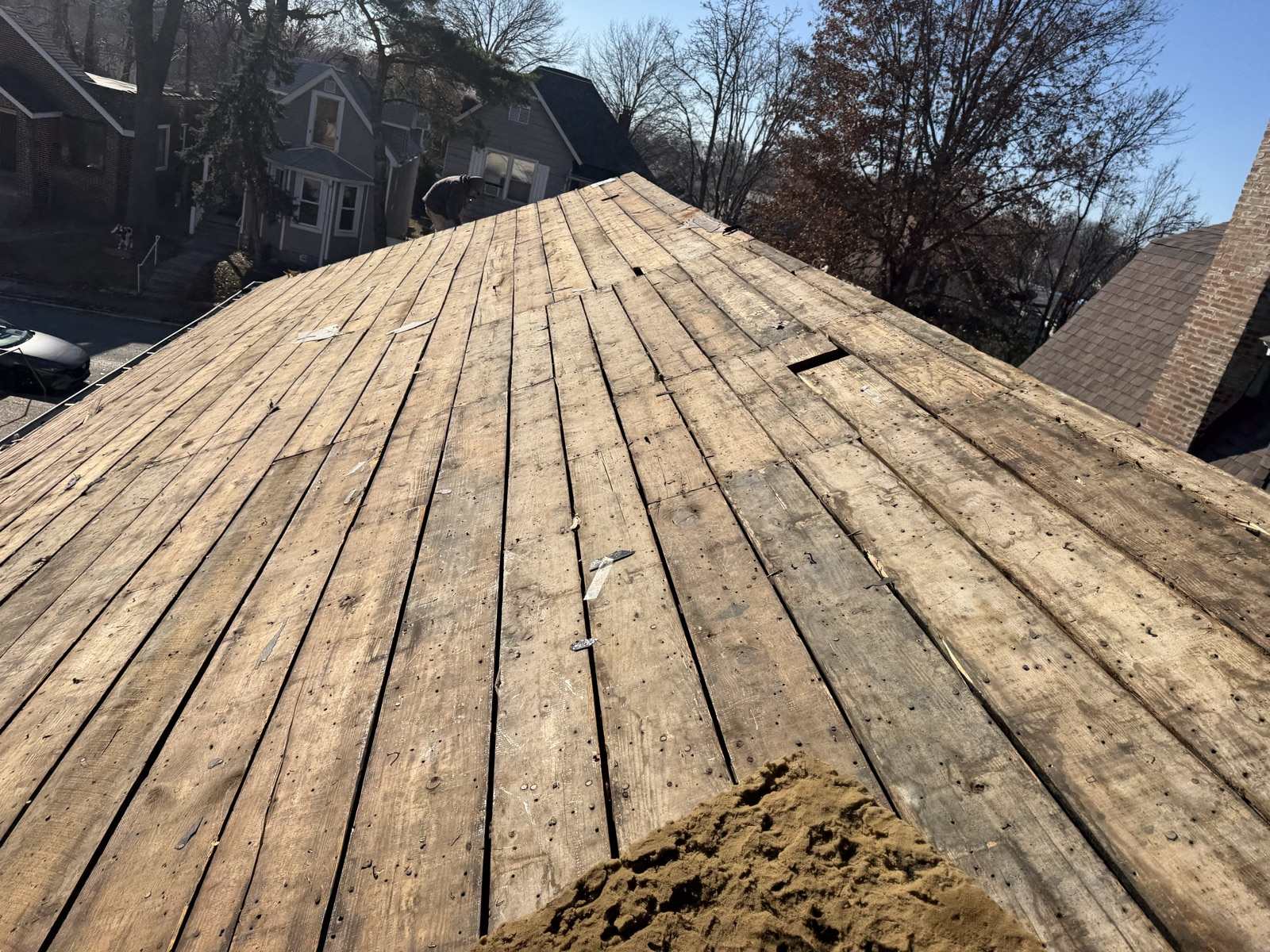
The Missouri year, working both ends against the middle
This is the mechanism, and it is specific enough to this climate to be worth spelling out. Missouri sits where cold continental air and warm Gulf air both reach, so the metro does not get one long cold season, it gets repeated crossings of the freezing point. Moisture in the deck and around a fastener freezes and expands, then thaws, then freezes again. Wood swells and shrinks with each cycle. The nail, which is not attached to the wood in any way other than friction, gets moved a fraction of a turn each time, and the movement is not symmetrical: it comes out further than it goes back in.
Then summer does the other half of the job. The deck under a dark roof runs far hotter than the air, the timber dries out and shrinks, and the grip on a shank that has already been loosened by winter gets weaker still. One year does very little. Twenty years of it, on plank decking that has already been nailed through several times by previous roofs, does a great deal.
Why this metro fails at its details
Freeze and thaw pulls the fastener out in winter. Deck heat loosens what is left of its grip in summer. The shingle field just gets old.
What a popped nail leaks like
Rarely dramatically, and that is what makes it a nuisance. A single open shank hole admits a small amount of water, and it usually only admits it when there is enough volume or enough wind to drive water under the tented course above. So the classic nail pop leak is intermittent, it correlates with heavy rain rather than any rain, and it produces a stain that grows very slowly over a season or two before anybody takes it seriously.
Because the amount of water is small, it also travels further before it emerges. A large volume of water finds the nearest way down. A small trickle follows the deck and the framing, which means the emergence point can be a long way from the fastener that let it in.
The repair, and the honest limitation
- Step oneFind them all, not just one Nails pop in patterns, because they were driven in patterns. A roof with one pop generally has a dozen, most of which are not leaking yet.
- Step twoLift, re-fasten, seal the abandoned hole The shingle is lifted, the offending nail is either driven properly or removed, a new fastener is set in sound wood clear of the old hole, and the old hole is sealed before the course goes back down.
- The limitBrittle shingles cannot be lifted All of the above depends on being able to lift a shingle without snapping it. On a roof that has lost enough oil and granule, that is no longer possible, and every attempted repair creates two new faults.
Where nail pops stop being a repair
Widespread popping across a whole roof plane is a signal about the deck as much as about the nails. If fasteners will no longer hold in the boards, new fasteners driven into the same boards will not hold either. That is a roof approaching the end of its service life, and the right conversation is repair or replace rather than another round of patching.
Hail, wind and the same mechanism
Storm damage and fastener failure are related, because a shingle that has been lifted by wind has usually been lifted around its fasteners, and a hail strike hard enough to bruise a shingle can also fracture the mat around the nail line. NOAA's Storm Events Database logged 125 hail events in St. Louis County between 2020 and 2025, with a maximum reported stone of 2.5 inches and an average of 1.32 inches. Those are counts of reported events rather than of insured losses, and reporting density tracks population, so a dense county logs more of them than a rural one for the same weather. What the number is good for is establishing that this is a metro where roofs get struck regularly, not for telling you whether your particular roof was struck. Only getting on it does that.