A shingle roof sheds, it does not seal
If somebody has offered to seal the spot above your stain, that is the repair that comes back. The fault is uphill of it and it has to be found before anything gets sealed, which takes a person on the slope with a camera and about an hour. The mechanism below is worth ten minutes of reading, because it is the reason cheap leak repairs in this metro fail twice.
The single most useful thing a homeowner can know about an asphalt roof is that it is not waterproof and was never meant to be. It is a shedding assembly. Each course of shingles laps over the one below, and as long as water is moving down the slope faster than it can work sideways or upwards, it never reaches the deck. Everything that goes wrong with a roof is some version of that arrangement being defeated: by a hole, by a lap that has been lifted, by water standing where it should be moving, or by wind pushing water up the slope.
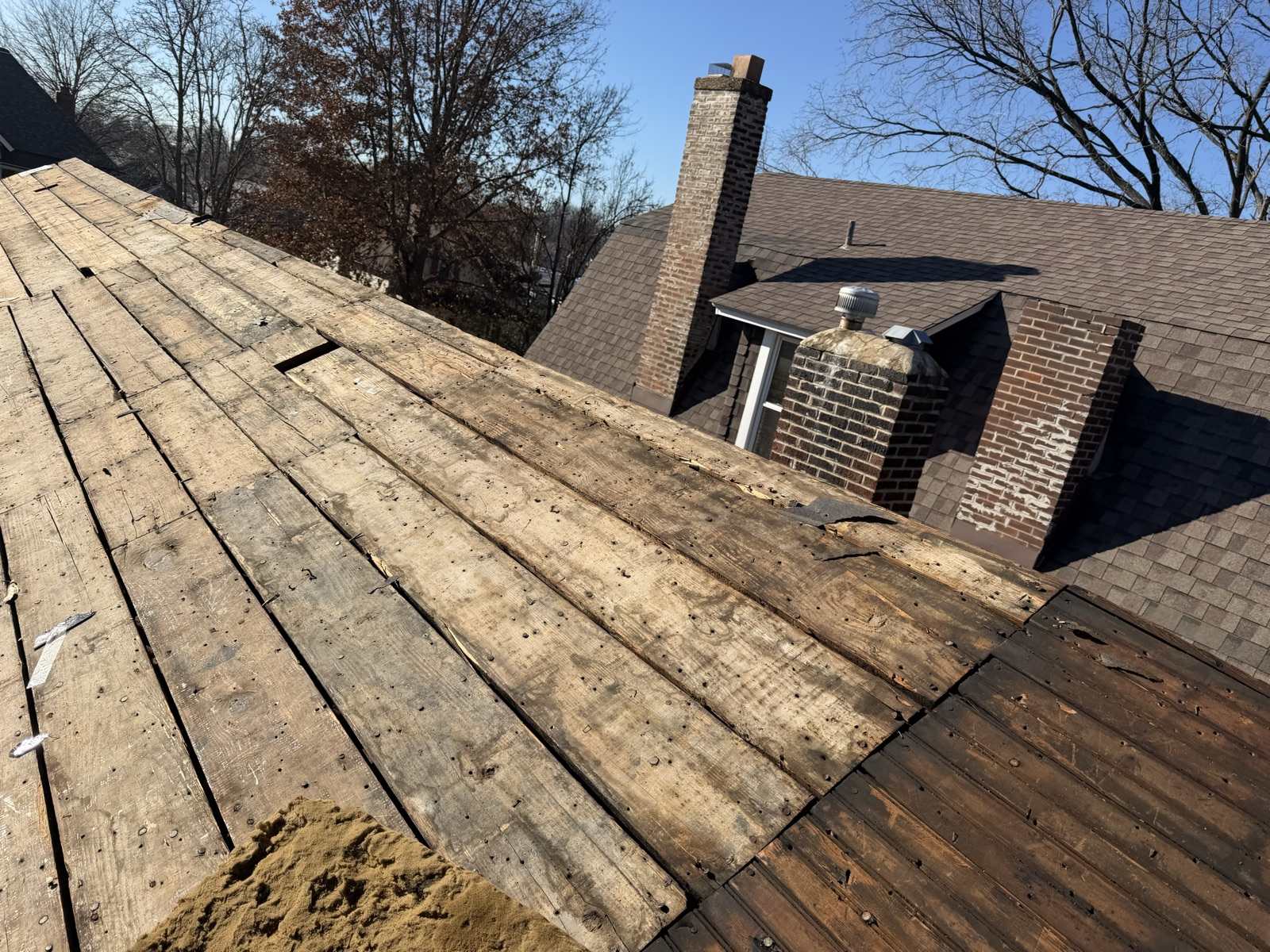
Below the shingles there is underlayment, felt or a synthetic sheet, lapped the same way and for the same reason. Below that is the deck. On post war ranch stock in the county the deck is usually plywood or oriented strand board, laid in sheets with small gaps at the joints. On the older city and inner suburban housing, and on a lot of two storey brick stock, the deck is sawn planks laid across the rafters with a deliberate gap between the boards. Those gaps were intentional. They are also, once water is on top of the deck, a set of ready made routes.
The three parts of a leak
- Part oneThe entry A discrete failure somewhere in the shedding assembly. In this metro it is overwhelmingly a detail rather than a hole in the field: a split boot, a flashing, a valley, a fastener that has come back out, a lap that ice has forced open.
- Part twoThe travel Water passes the shingles and lands on the underlayment or the deck. Now it is inside the assembly and out of the wind, and it moves the way any thin film of water on a sloped surface moves: downhill, but deflected by every seam, fastener, batten and dip it meets. It can run along a felt lap for a long way. It can enter a plank seam and travel sideways with the board. Once it reaches a rafter it will usually run down the side of it, because the corner between rafter and deck is the lowest point available.
- Part threeThe emergence Water only leaves the structure where something stops it: a ceiling joist, a run of insulation, an electrical box, a wiring staple, a drywall seam, a light fitting. That is where it pools and soaks through, and that is where you see it.
Put plainly
The ceiling tells you where the water was finally stopped. It does not tell you where the water got in.
How far, in practice
- Steep roof, sheet deck
- Often short. A foot or two of travel, sometimes almost none, which is why steep simple roofs are the easiest to diagnose.
- Plank deck, any slope
- Several feet is routine. The seam between two boards is a channel, and water that finds one will follow it until the board stops or dips.
- Down a rafter
- The full length of the rafter is possible. A leak that enters near the ridge can emerge at the outside wall, one whole storey and one whole room away.
- Low slope, over a porch or an addition
- The worst case. Very little gravity pulling water down through the assembly, a lot of surface to run across, and often a shallow cavity with no attic to inspect from.
- Along a wire or a pipe
- Water follows anything that offers a continuous surface. A cable stapled across the underside of a deck is an excellent aqueduct and will deliver water to a light fitting several feet from where it started.
What this changes about a repair
It changes the direction of the search. A roofer who has understood this does not start at the point above the stain, because that point is a conclusion, not evidence. The search starts at the stain and works uphill and outwards: everything on the slope above it, and a generous margin either side, with particular attention to anything that penetrates the roof or meets a wall.
It also changes what counts as a finished job. A repair that seals one detail on a roof where three details are failing is not finished, it is one third finished, and the homeowner will experience it as a repair that did not work. That is why a proper leak visit looks at every penetration and every flashing on the affected slope rather than only the one that happened to be found first.
Finally, it explains why an old repair is such a good clue. A bead of sealant on a roof is somebody's record of where they thought the leak was. If the stain is still growing, they were wrong, and the fact that they were wrong at that exact spot tells you something useful about where to look next.
The one exception worth naming
Not everything that stains a ceiling is a leak. Warm moist air from a bathroom or a kitchen, vented into an attic instead of out through the roof or the soffit, condenses on the cold underside of the deck in winter, runs, drips, and produces a stain that behaves almost exactly like a roof leak except that it appears in cold weather rather than in rain. If your stain is a January stain and not a thunderstorm stain, the problem may be ventilation rather than roofing, and the fix is a different one. It is worth checking before anybody sells you shingles.